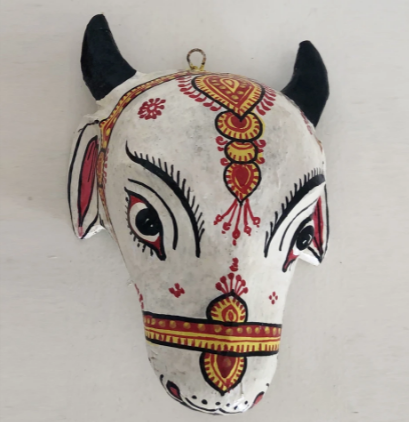
Jharkhand is home to a wide range of folk dance traditions, most notably Chhau, in which performers fully embody their roles through highly codified movements of the hands, feet, and torso. Dancers assume the identities of mythological and symbolic figures—such as Rama, Ravana, and Hanuman—as well as animals, birds, hunters, natural phenomena like night and the rainbow, and other allegorical forms. These transformations are made possible through the use of elaborate masks, which are central to the performative language of the dance.
The masks are traditionally crafted using papier-mâché, a technique that is also employed to create sculptural representations of animals and human figures, ornamented boxes, and images of gods and goddesses. The production process follows a consistent and carefully sequenced method. Abundant dark clay, sourced from local riverbeds, is first shaped into a basic model and left to dry until it hardens. Once set, thin muslin cloth is applied over the clay form, followed by multiple alternating layers of paper and muslin—or, in some cases, layers of newspaper alone—built up gradually, often up to twenty layers.
These layers are bonded using a homemade adhesive prepared from wheat flour and water, boiled and stirred until it reaches a thick, glue-like consistency. A final layer of cloth—typically repurposed household textiles such as old saris or dhotis—is dipped into a liquid clay mixture and applied over the structure. The surface is then coated with a thick layer of clay and left to dry in strong sunlight for two to three days, allowing it to harden naturally. Once fully dried, the inner clay mould is carefully removed, leaving the mask hollow. Facial features such as eyes, noses, and expressions are refined using sharp tools as required.
Before colouring, a primer coat of lime or khalli mitti is applied to prepare the surface. Bright pigments—red, yellow, green, blue, black, and others—are then layered onto the mask, with particular attention given to facial expression and emotional intensity. Symbolism is embedded not only in colour but also in form, making the masks visually expressive and narratively legible. Once painted, the masks are further embellished with decorative elements such as flowers (natural or synthetic), metallic foils, and peacock feathers, many of which are sourced from Bengal or emerging markets within Jharkhand.
Prominent centres of mask production include Saraikela, Bundu, and Tamar, all within the Ranchi district. While these masks remain deeply rooted in ritual and performance contexts, contemporary demand has also reshaped their circulation. Increasingly, they are produced for decorative and interior use, responding to modern aesthetic preferences while continuing to draw on long-established craft knowledge and performance traditions.
The market value of these masks varies according to size, complexity, and ornamentation, typically ranging from approximately ₹100 to ₹1,500 per piece. Their most vital and sustained function, however, lies in their use within Chhau performances in Jharkhand, particularly in Saraikela, where the tradition remains most visibly anchored.
Chhau is a masked dance form grounded in Hindu mythology, regional folk narratives, and contemporary social themes. Characteristically, Chhau masks are devoid of overt facial expression; emotional intensity and narrative meaning are instead conveyed through the dancer’s body language—precise, controlled, and at times restrained, at other times vigorous and forceful. This deliberate absence of expression on the mask heightens the importance of gesture, posture, and movement as the primary vehicles of affect and storytelling.
The iconographic range of Chhau masks is extensive. Subjects include the ten-headed Ravana, Rama, Lakshmana, Hanuman, and other figures drawn from the Ramayana and the Mahabharata, alongside monkeys and other attendant characters. Masks also represent figures drawn from local folklore—birds, animals, spirits such as chirkuni or ghosts—as well as personifications of natural elements like night or the sea. In addition, everyday social types such as boatmen, fishermen, and hunters appear, as do contemporary figures reflecting modern social concerns and philanthropic ideals.
Visually, Chhau masks are strikingly colourful and richly ornamented, designed to register clearly during performances staged on raised platforms in village squares. They are often embellished with beads, metallic sequins, and other decorative elements that enhance their visual impact under open-air conditions. Through repeated cycles of making, performance, and renewal, these papier-mâché masks are continually reanimated by artisans, sustaining both the aesthetic vitality of Chhau and the interdependence of craft and performance within the region’s living cultural traditions.


Access 70,000+ practitioners in 2500+ crafts across India.

10,000+ listings on arts, crafts, design, heritage, culture etc.

Rich and often unfamiliar vocabulary of crafts and textiles.

Needs to be written.